BCI’s private equity group is pleased to share news of three new senior leadership positions that will further build our robust investment, portfolio oversight, and value creation strategies.
Blake Fizzard has been named Senior Managing Director, Global Operations, overseeing the private equity group’s operations across all locations, including non-investment strategic planning, and will remain active in his current Board of Director appointments. Blake joined BCI in 2016 and most recently served as Senior Managing Director, Private Equity.
Julian Remedios has been named Senior Managing Director, Global Investments, overseeing the private equity group’s investment processes, including value creation and sourcing of new investment opportunities. Julian joined BCI in 2006 and most recently led BCI’s global healthcare team as Senior Managing Director, Private Equity.
Umar Malik has been named Senior Managing Director, Chief of Finance, overseeing the private equity group’s financial management and portfolio insights. Umar joined BCI in 2018 and most recently served as BCI’s Senior Vice President, Finance and Chief Financial Officer. More information on our finance team’s changes can be found here.
“We are proud to recognize the substantial contributions of Blake, Julian, and Umar, which reflect BCI’s commitment to rewarding excellence and building a best-in-class team, ultimately driving long-term value for our clients,” said Jim Pittman, Executive Vice President & Global Head, Private Equity.
British Columbia Investment Management Corporation (BCI) is pleased to announce that Reg Bawa will join the BCI Board of Directors on January 1, 2024. The Teachers’ Pension Board of Trustees has appointed Reg for a three-year term.
“On behalf of the Board of Directors, I would like to welcome Reg to the BCI Board,” said Peter Milburn, Chair of BCI’s Board of Directors. “Reg brings more than 30 years of experience and leadership in public service, combined with a strong background in governance and finance.”
“I am honoured to be joining the BCI Board,” said Reg. “We have a shared goal of helping our client boards build a financially secure future for hundreds of thousands of British Columbians, and I look forward to working with my fellow colleagues to continue to provide effective oversight and governance.”
Reg succeeds Rob Taylor as the Teachers’ Pension Plan member on the BCI Board. Rob, who is completing his term on December 31, 2023, has served on the Board since 2022 as a Director and member of the Audit Committee.
“We sincerely thank Rob for his important contributions and commitment to the strong, independent governance of BCI,” added Peter.
Reg has served as a trustee on the Teachers’ Pension Board of Trustees since 2010. He recently completed a two-year term as Chair and will serve as Vice-Chair in 2024. Reg is the Assistant Deputy Minister of Policy, Programs, and Partnerships at the Ministry of Transportation and Infrastructure. His career with the British Columbia Public Service spans more than 30 years. During that time, Reg has held senior positions with the Ministry of Education, Ministry of Children & Family Development, Provincial Treasury, Provincial Revenue, and Office of the Comptroller General and has also been responsible for leading finance, strategic human resources, and IT for large complex ministries. Reg is a Chartered Professional Accountant (CPA, CGA).
BCI’s Board is structured in accordance with the Public Sector Pension Plans Act. BCI’s four largest pension plan clients each appoint a member from their Board of Trustees, with the Minister of Finance appointing the Chair and two directors to comprise a seven-member Board.
More information about BCI’s Board of Directors can be found here.
We use our influence as an asset owner to drive ESG improvements within our portfolio and across the broader capital markets. We believe that strong ESG practices will ultimately lead to stronger performance.
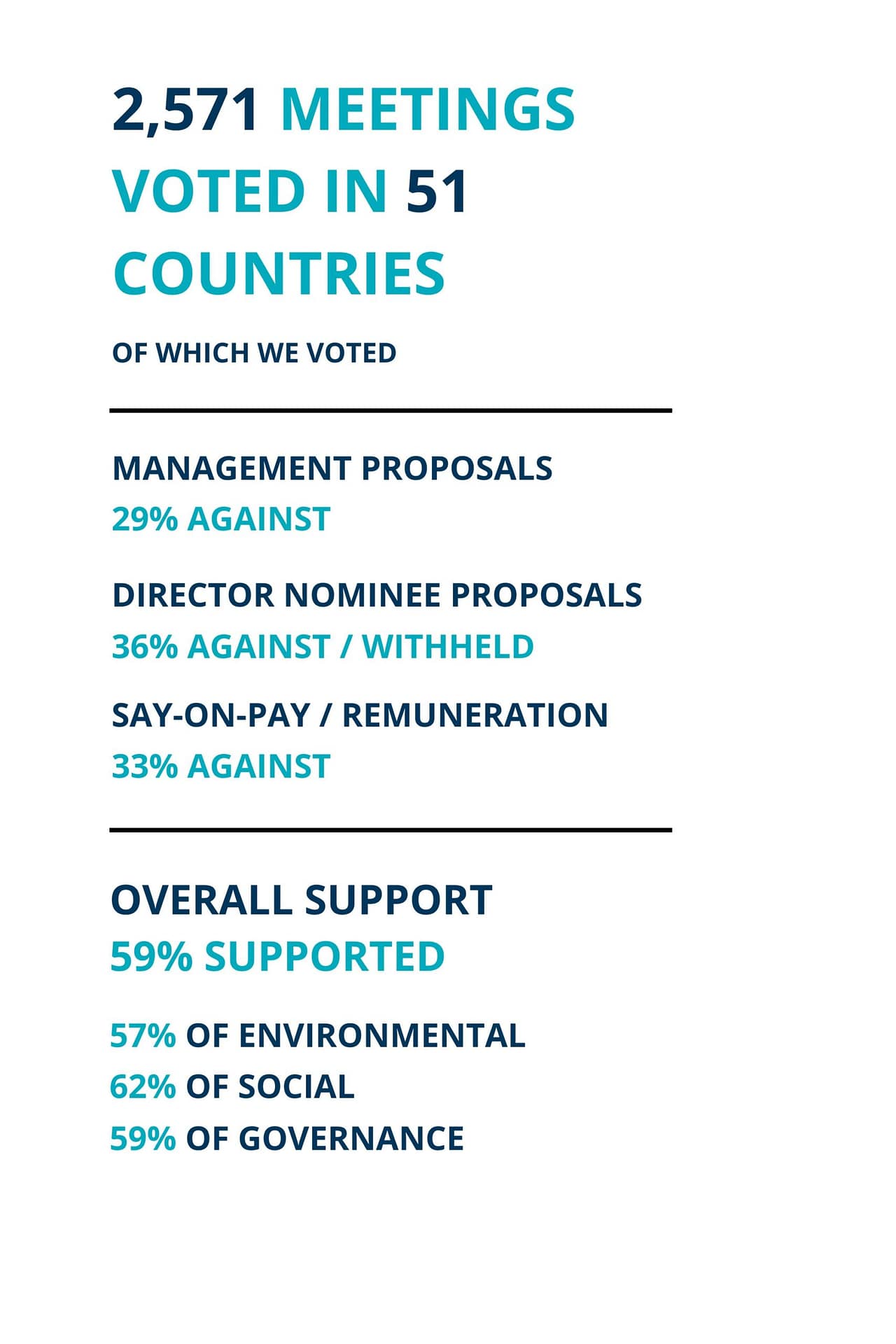
Proxy voting, an ownership right that allows BCI to participate in the decisions of public companies, is a powerful way we apply our influence. We aim to vote at the meetings of every public company in our portfolio and we publish these votes, in real time, through a transparent database on our website. We vote according to our Proxy Voting Guidelines which are updated every two years to reflect the evolving expectations we have for the public companies in our portfolio.
This voting season, from March to June 2023, was very active for us with 2,571 ballots cast globally. BCI’s support for shareholder proposals overall remained unchanged from the previous year at 59 per cent with minor increases for environmental and governance proposals and a slight drop for social proposals. This drop was largely driven by an overly prescriptive proposal filed at a dozen U.S. companies which received minimal support.
Environmental and Social Proposals
While a record number of environmental and social (E&S) shareholder proposals were filed in the U.S.; hundreds were withdrawn, indicating filers likely succeeded in getting companies to agree to the proposals’ asks. About 340 E&S proposals made it to the ballot, an increase from 300 in 2022.
Despite an increase in filing volume, average support for E&S proposals dropped to around 20 per cent this year from the high in 2021 which averaged just above 30 per cent.
Of note, there were substantially fewer governance proposals in the last two years as the focus shifted to E&S topics, with the exception of proposals seeking independent chairs and the separation of CEO and board chair roles, which doubled.
A Closer Look: Key Actions
Imperial Oil: BCI filed our own climate-related shareholder proposal calling for increased climate risk disclosure at Imperial Oil. This was the first proposal of its kind filed by a large Canadian public sector pension investment manager going to a vote at a Canadian company. BCI was the sole filer on the proposal, which garnered the support of nearly 20 per cent of all publicly held voting shares (excluding parent company Exxon’s controlling shares).
Meta Platforms: BCI supported a shareholder proposal asking Facebook’s parent company to set targets and publish an annual performance assessment regarding child safety impacts on its platform. The proposal won 17 per cent support, which is substantial since the founder controls 61 per cent of votes.
Cenovus Energy: BCI supported a proposal requesting an assessment of how the company’s climate lobbying activities align with its net-zero goal. Management supported the proposal and it received 99.5 per cent support. BCI expects companies’ lobbying activities to align with their public commitments on environmental or social factors.
Citigroup: BCI supported a proposal that asked Citigroup Inc. for a report on the efficacy of the company’s practices in ensuring its financing activities respect international standards for Indigenous Peoples’ rights. The proposal received significant support at just over 30 per cent.
The Path Ahead
Our work doesn’t stop at the ballot. After we vote, BCI directly follows up with select portfolio companies to ensure they understand our rationale and expectations. We also closely review our voting record to see how we made an impact and find areas to refine our approach. This review is an important step in preparing for any repeat shareholder proposals and will inform our biennial Proxy Voting Guideline update planned for 2025.
Proxy voting is part of a broader stewardship program at BCI, which also includes a significant focus on direct and collaborative engagement and policy advocacy work. As responsible stewards of our clients’ assets, acting as an engaged and committed investor is crucial to ensuring the long-term sustainability of our investments.
British Columbia Investment Management Corporation (BCI) is pleased to announce that Peter Milburn has been reappointed as Chair of BCI’s Board of Directors for an additional two years by the Honourable Katrine Conroy, M.L.A., Minister of Finance for British Columbia.
Peter was appointed the Chair of BCI’s Board on December 31, 2016, and has been reappointed until December 31, 2025.
“It is an honour and a privilege to be reappointed as the Board Chair,” said Milburn. “Working alongside such a dedicated and visionary group of individuals, on our Board and leadership team, has been a truly enriching experience. I want to acknowledge the collaborative spirit and commitment to our shared goals that each of our clients brings to the table. Our collective efforts have undoubtedly played a significant role in the achievements we’ve celebrated together, and I am excited about the opportunities that lie ahead.”
Peter previously served as the provincial Deputy Minister of Finance and Secretary to the Treasury Board. Prior to that appointment, Peter built his career within the British Columbia Ministry of Transportation and retired after 33 years in various roles such as Deputy Minister, Chief Operating Officer, and Executive Project Director for the Sea to Sky Highway Improvement Project. Peter holds a Bachelor of Applied Science in Civil Engineering from the University of British Columbia.
BCI’s Board is structured in accordance with the Public Sector Pension Plans Act. BCI’s four largest pension plan clients each appoint a member from their Board of Trustees, with the Minister of Finance appointing the Chair and two directors to comprise a seven-member Board.
More information about BCI’s Board of Directors can be found here.
Victoria, B.C. – British Columbia Investment Management Corporation (BCI) is pleased to announce the appointment of Jeremy Trickett as Senior Vice President, Legal Affairs & Chief Legal Officer. Jeremy will lead BCI’s legal and compliance departments with enterprise-wide responsibility for supporting transactional, investment, and operational activities to ensure the investment needs of our clients are met.
Jeremy brings extensive professional leadership and international private practice experience. Before joining BCI, Jeremy served as Senior Vice President & Chief Governance Officer at Great-West Lifeco Inc. He holds an Honours BA, JD, and an LLM, and is a member of the law societies of Ontario, Alberta, Manitoba, and England and Wales.
“We are delighted to have Jeremy join BCI and oversee our legal and compliance teams. Jeremy has a proven track record of leading high-performance teams, and his international experience will be invaluable as we continue to grow our footprint as an active global investor,” said Shauna Lukaitis, Chief Operating Officer.
“I am excited to join such a prominent global asset manager and look forward to contributing to BCI’s continued success in investing globally on behalf of British Columbia’s public sector clients,” said Jeremy. “It is a privilege to join at this pivotal time alongside such a talented team,” he added.
Victoria, B.C. – British Columbia Investment Management Corporation (BCI) congratulates Gordon J. Fyfe, Chief Executive Officer and Chief Investment Officer, on his appointment to the Order of British Columbia. This esteemed honour is a testament to Gordon’s remarkable career accomplishments and commitment to British Columbia.
The Order of British Columbia is the province’s highest form of recognition and is awarded to individuals who have made exceptional contributions through outstanding achievements, dedication, and service across various fields.
“Having grown up in Victoria, it is a privilege to lead the provider of investment management services for the province’s public sector. Not only does our work ensure financial security for pensioners and insurance funds, it promises enduring benefits for generations of British Columbians to come,” says Gordon J. Fyfe, Chief Executive Officer and Chief Investment Officer.
“I am humbled to be appointed to the Order of British Columbia alongside many distinguished leaders in our community, and want to extend my gratitude to those who have profoundly influenced my own journey. I look forward to continuing to contribute to our province’s prosperity, resilience, and success.”
Gordon’s appointment celebrates his significant contributions, including transforming BCI into a leading global investor and one of Canada’s largest asset managers as well as advancing the broader investment industry. Under his leadership, BCI:
Achieved a 10-year annualized return of 8.5 per cent for our six largest pension clients, equivalent to $16.3 billion in cumulative added value, surpassing the benchmark of 7.2 per cent and ensuring our pension clients remain fully funded;
Increased assets under management to $233.0 billion1 as of March 31, 2023, up from $121.9 billion2 within eight years;
Expanded assets managed in-house to 82 per cent of the total portfolio in 2023 from 57 per cent in 2016 and diversified returns, including increased exposure to private markets;
Grew the team to more than 700 dedicated employees and established three new offices in strategic locations: Vancouver, New York, and London, U.K.;
Championed the integration of ESG factors into investment decisions and active asset management internally and across capital markets;
Developed an award-winning co-op and intern program, providing valuable opportunities for students from British Columbia and across Canada; and
Founded QuadReal Property Group to expertly manage our clients’ global real estate equity and debt programs.
BCI is proud of this well-earned recognition, which underscores the exemplary leadership of our CEO/CIO together with his commitment to serving our clients and their beneficiaries across British Columbia.
The Order of British Columbia investiture ceremony for 2023 recipients will take place at Government House in Victoria in the late fall.
ABOUT BCI
British Columbia Investment Management Corporation (BCI) is amongst the largest institutional investors in Canada with C$233.0 billion in gross assets under management, as of March 31, 2023. Based in Victoria, British Columbia, with offices in Vancouver, New York City, and London, U.K., BCI manages a portfolio of diversified public and private market investments on behalf of our 32 British Columbia public sector clients.
With a global outlook, BCI integrates ESG factors into investment decisions and activities that convert savings into productive capital to meet clients’ risk and return requirements over time. Founded in 1999, BCI is a statutory corporation created by the Public Sector Pension Plans Act. For more information, visit BCI.ca or LinkedIn.
CONTACT
Olga Petrycki, Director, External Stakeholder Engagement
1 Gross assets under management, including clients’ investment liabilities achieved through government bond repurchase agreements. 2 Net assets under management.
Today, CEOs of 11 of Canada’s leading pension plan investment managers, representing more than $2 trillion in assets under management, call on companies focused on long-term value to embrace the new International Sustainability Standards Board (ISSB) disclosure framework, launched this week.
Together, Alberta Investment Management Corporation (AIMCo), British Columbia Investment Management Corporation (BCI), Caisse de dépôt et placement du Québec, CPP Investments, Healthcare of Ontario Pension Plan (HOOPP), Investment Management Corporation of Ontario, OMERS, OPTrust, Ontario Teachers’ Pension Plan, OPTrust, PSP Investments and University Pension Plan have issued a joint statement in support of the inaugural ISSB standards (“Standards”). The new ISSB standards help consolidate existing disclosure standards including the Sustainability Accounting Standards Board (SASB) standards and the Task Force on Climate-related Financial Disclosures (TCFD) framework.
The CEOs said they believe widespread adoption of this new global baseline will spur companies to more closely examine and manage activities that are having an increasingly material impact on long-term value creation.
The joint statement declares that Canada’s pension plan investment managers “are mandated to deliver long-term risk-adjusted returns that help support retirement and benefit security for millions of people. In 2020, many of our organizations spoke about the importance of companies and investment partners placing long-term sustainability of their business at the centre of their strategic planning, operations, and reporting. We believe that integrating material sustainability-related factors into our strategies and investment decisions is an integral part of the duty that many of us owe to clients, contributors and beneficiaries. Understanding these factors helps us individually work to unlock opportunities and mitigate risks.
How companies identify and address issues such as diversity and inclusion, human capital, board effectiveness and climate change can significantly contribute to value creation or erosion. Companies have an obligation to disclose their material business risks and opportunities to their investors and, in our view, should provide financially relevant, comparable, and decision-useful information.
For our part, we will continue to strive to strengthen our own sustainability disclosures and allocate capital to businesses best placed to preserve and create value over the long run.”
The ISSB, which released the new standards on June 26, said this new framework will help to improve trust and confidence in company disclosures about sustainability to inform investment decisions. For the first time, the Standards create a common language for disclosing the effect of climate-related risks and opportunities on a company’s prospects, the ISSB noted.
The Standards have been developed to be used in conjunction with any accounting requirements under the International Financial Reporting Standards (IFRS).
IFRS S1 provides a set of disclosure requirements designed to enable companies to communicate to investors about the sustainability-related risks and opportunities they face over the short, medium and long term.
IFRS S2 sets out specific climate-related disclosures and is designed to be used with IFRS S1.
Both fully incorporate the TCFD recommendations.
The ISSB developed IFRS S1 and IFRS S2 with the benefit of extensive market feedback and in response to calls from the G20, the Financial Stability Board (FSB) and the International Organization of Securities Commissions (IOSCO), as well as leaders in the business and investor community. This support for a comprehensive global baseline of sustainability-related disclosures demonstrates the widespread demand for a consistent understanding of how sustainability factors affect companies’ prospects.
Proposal is the first of its kind for a large Canadian public sector pension investment manager
Victoria, British Columbia – British Columbia Investment Management Corporation (BCI) filed a shareholder proposal calling for Imperial Oil Limited (Imperial Oil) to increase disclosure on climate risk. This is the first climate-related shareholder proposal filed by a large Canadian public sector pension investment manager going to a vote at a Canadian company. BCI is the sole filer on the proposal, which will be presented at Imperial Oil’s annual general meeting on May 2, 2023.
“Disclosure of accounting assumptions related to climate change and the energy transition is a fast-emerging shareholder expectation,” says Jennifer Coulson, senior managing director & global head, ESG. “We require transparent accounting disclosure in financial statements to make informed investment decisions, including visibility over off-balance sheet liabilities, and Imperial Oil has not provided sufficient information.”
The proposal requests that Imperial Oil’s Board of Directors provide an audited report estimating the impacts of the International Energy Agency Net Zero by 2050 pathway on all asset retirement obligations by February 2024. Asset retirement obligations are the costs associated with the regulatory requirement to decommission assets at the end of their life. Companies account for certain future costs through financial statements, and we expect to have visibility of current off-balance sheet liabilities of assets with indefinite useful lives.
In addition to the shareholder proposal, BCI has voted against key directors at the upcoming meeting. These votes are based on our assessment that the company’s lack of risk oversight has led to major controversies related to tailings integrity and insufficient Indigenous engagement.
Taking action on climate change for more than 20 years, BCI has supported the Climate Action 100+ collaborative engagements with Imperial Oil and its majority shareholder Exxon Mobil Corporation (ExxonMobil) since 2017. BCI has co-filed a similar proposal at ExxonMobil. These actions reflect an escalation of our engagement efforts and align with the expectations and goals of Climate Action 100+.
CONTACT
Olga Petrycki
Director, External Stakeholder Engagement media@bci.ca
ABOUT BCI
British Columbia Investment Management Corporation (BCI) is amongst the largest institutional investors in Canada with C$211.1 billion under management, as of March 31, 2022. Based in Victoria, British Columbia, with offices in Vancouver, New York City, and London, U.K., BCI is invested in: fixed income and private debt; public and private equity; infrastructure and renewable resources; as well as real estate equity and real estate debt through our independently operated platform company QuadReal Property Group. With our global outlook, we seek investment opportunities that convert savings into productive capital that will meet our clients’ risk and return requirements over time. This compels us to integrate long-term ESG matters into all investment decisions and activities. BCI’s clients include pension plans representing over 715,000 plan members, insurance funds providing more than three million Autoplan insurance policies annually, benefits coverage to more than two million workers and 225,000 companies, and special purpose funds within British Columbia’s public sector. Founded in 1999, BCI is a statutory corporation created by the Public Sector Pension Plans Act.
In April 2022, we launched an internally managed strategy in the Active Emerging Markets Equity Fund. The strategy provides cost and operational efficiencies for clients, while allowing us to use our deep expertise to capture long-term growth opportunities through internal, active management. It also enables us to expand our in-house emerging markets experience. During the development of the strategy, we focused on tailoring our ESG analysis to the unique considerations for emerging markets. Jean-Christophe, Managing Director, Global Emerging Markets, describes how ESG was integrated into the strategy from the outset.
Why is ESG important in emerging markets?
Emerging markets are at the forefront of systemic issues like climate change. However, emerging markets have generally not yet reached developed markets’ level of sophistication in terms of regulation, disclosure, corporate governance, and other ESG considerations. ESG data is also more scarce and less reliable in emerging markets. As a result, risks of ESG-related financial impacts can be higher than in developed markets, both at the company and country levels. This is why it is important to integrate ESG throughout our investment process.
How did BCI build ESG into the strategy?
We incorporated ESG principles while drafting the strategy’s initial business plan, helping establish our embedded approach to ESG from day one. Close collaboration between BCI’s dedicated ESG and investment teams ensured we fully considered ESG at the company, sector, and country levels. When we launched the strategy, we built tailored analytical tools to assess ESG data and analyze the investment universe for ESG considerations.
How is ESG factored into ongoing management?
With our ESG colleagues, we continually review the emerging markets landscape through an ESG lens and anticipate shifts that could impact the portfolio. A member of the ESG team participates in our daily meetings to exchange insights and discuss our engagement strategies with companies. Each quarter, we conduct a global ESG review of the portfolio and openly discuss ESG risks and opportunities in the investment universe.
For each investment, we analyze expected returns and ESG considerations. For example, governance can be challenging in emerging markets. We flag issuers where managers are trading shares of their own companies. We encountered this twice in 2022 and reviewed the implications with our ESG colleagues. In the case of one company, the poor practices eroded our conviction and the stock was not selected for the portfolio. Through engagement with the second company, we were able to influence improvements and continue to hold the stock in our portfolio.
As our exposure to private markets continues to grow, so do our specialized ESG expertise and in-house resources. Building on more than a decade of ESG action in private markets, BCI welcomed dedicated ESG professionals to support our programs in 2022. Learn more from Evan Greenfield, managing director, ESG, who supports private equity, as he shares his perspectives on the implications and possibilities for ESG in private markets.
How is ESG evolving in private markets?
The COVID-19 pandemic was a watershed moment for the ESG movement. During a time of significant volatility, ESG integrated funds in the public markets outperformed their non-ESG integrated benchmarks, which led to an inflow of capital to ESG strategies. During this period, the private equity asset class started to recognize the benefits of ESG integration especially from risk reduction and return enhancement. We believe that ESG will continue to have a significant impact in the private equity market as it is well suited for our asset class. Private equity investors can influence management behaviour and company strategy, given their ownership positions and governance rights, and the longer-term hold periods. ESG integration is at the beginning of a long-term structural change to private equity investing.
Which key considerations are informing the investment landscape?
Private equity is unwavering about value creation during the life of the investment, and focusing on material ESG factors fits squarely into the value creation model. We see several catalysts that will continue to advance the focus on sustainability. These include a shift in purchasing decisions to incorporate sustainability, talent looking to work with firms where there is a mission around purpose, increased regulation, credit ratings that integrate material ESG factors, and greater flows of capital to sustainable-oriented strategies
What will you focus on in 2023?
Private equity’s ESG focus in 2023 is centred around continuing to build a highly scalable ESG program. We want to ensure all our investment professionals have the knowledge and tools to seamlessly integrate ESG throughout the investment process: screening, due diligence, monitoring, value creation, and exit. At the core of this approach is engaging with each of our six sector teams — financial services, business services, healthcare, consumer, industrials, and technology, media, and telecom — and developing an internal view on material ESG factors for the industry segments with clear financial linkages. We will also proactively support our portfolio company management teams to educate them on emerging ESG topics. We want to ensure our portfolio companies have the tools to make ESG diffusive through their organizations. This will ensure they are able to recognize the disruptive challenges and opportunities in a sustainability-integrated economy.
 Back to News