Topic for News: Corporate

  • Accelerating innovation: Strategic investment in AI delivers recognition and results 

    Accelerating innovation: Strategic investment in AI delivers recognition and results 

    Desktop

    Accelerating innovation: Strategic investment in AI delivers recognition and results 

    Insights
    Back to Insights Back to Insights
    December 16, 2025

    In the highly competitive global investment landscape, innovation is crucial for delivering long-term, sustainable value to our clients. This is why accelerating innovation is one of three strategic ambitions guiding BCI through fiscal 2025 to 2027.

    Two recent industry awards from Info-Tech Research Group, for being an Innovator of the Year 2025 and CIO Awards Canada 2025 for using IT in innovative ways to deliver business value, recognize this approach and reflect more than just technical achievements at BCI. They showcase how we’re building the capabilities and culture needed to compete as a world-class asset manager.

    Why innovation matters to BCI

    The investment environment is ever-changing, and to keep pace, BCI is adopting the latest technology to automate complex analysis, create scalable processes, and mitigate risks associated with manual workflows. Artificial intelligence (AI) and advanced analytics have become essential tools for maintaining competitive advantage while growing operational efficiency on a global scale.

    For BCI, innovation creates three critical advantages: it optimizes how our talent works, enhances decision-making capabilities, and maintains the agility needed to navigate changing markets successfully.

    “Innovation is fundamental to how we operate as a global asset manager and deliver sustainable value for our clients,” said Shauna Lukaitis, Chief Operating Officer. “These awards recognize something essential about our approach – we’re building differentiated capabilities in-house. What’s most meaningful is seeing our teams embrace an innovation mindset and challenging how we’ve traditionally operated. This internal capability building is critical to executing our strategic ambitions and maintaining the agility required to navigate increasing complexity”.

    Building a culture of experimentation

    Innovation requires more than adopting new systems. It requires cultural transformation. We’ve focused on empowering employees across all business functions to experiment, take measured risks, and challenge existing processes.

    This shift began with our inaugural Innovation Challenge in early 2024, which invited employees to reimagine how BCI operates. Strong employee uptake transformed this initiative into a structured innovation ecosystem, including an internal idea platform and training programs to build capabilities across the organization.

    The Info-Tech Research Group’s Innovator of the Year 2025 recognition acknowledges this transformation. It reflects a sustained commitment to embedding innovation into BCI’s operating model, highlighting how we create and execute solutions internally. This same philosophy guided our transformation into an active, in-house global asset manager more than a decade ago.

    From concept to impact: AI-powered invoice processing

    The CIO Awards Canada 2025 recognition demonstrates how cultural ambition translates into practical results. Our Technology and Finance teams developed an AI-powered invoice processing system entirely in-house, applying a build-versus-buy approach.

    Previously, BCI processed hundreds of invoices weekly through manual workflows that were time-consuming and prone to error. The new platform automates the full invoice lifecycle — from receipt through approval and reconciliation — using machine learning, computer vision, and natural language processing.

    The outcomes demonstrate clear value: processing time is significantly reduced without sacrificing accuracy, the system continuously improves through machine learning, and a mobile interface supports our global operations by enabling approvers to review invoices from anywhere.

    Building capabilities for sustainable growth

    These awards reflect collaborative efforts across BCI to find new ways to deliver value while building capabilities that will serve BCI for years to come. As we continue to execute our fiscal 2025-2027 strategic ambitions, innovation remains central to how we compete globally and deliver sustainable growth for our clients.

    Discover how we’re delivering on our ambitions in our F2025 Annual Report.

  • Peter Milburn reappointed as BCI Board Chair

    Peter Milburn reappointed as BCI Board Chair

    Desktop

    Peter Milburn reappointed as BCI Board Chair

    News
    Back to News Back to News
    December 14, 2025

    BCI is pleased to announce that Peter Milburn has been reappointed as Chair of BCI’s Board of Directors by the Honourable Brenda Bailey, Minister of Finance for British Columbia.

    The reappointment extends Peter’s term to December 31, 2026.

    “I am honoured to continue to serve as BCI’s Board Chair. During my tenure, I have had the privilege to be part of BCI’s transformation into a $295 billion global asset manager designed to deliver long-term, sustainable value for our clients,” said Peter. “I am also grateful for the trust our clients continue to place in us, as well as the dedication of BCI’s leadership and employees. In an ever-changing world, the Board and I remain committed to the strong governance and client service that has defined BCI for more than 25 years.”

    Peter was first appointed as Chair in 2016. He previously served as the provincial Deputy Minister of Finance and Secretary to the Treasury Board. He built his career within the British Columbia Ministry of Transportation and retired after 33 years serving in various roles including Deputy Minister, Chief Operating Officer, and Executive Project Director for the Sea to Sky Highway Improvement Project. Peter holds a Bachelor of Applied Science in Civil Engineering from the University of British Columbia.


    About the BCI Board of Directors


    BCI’s Board is structured in accordance with the Public Sector Pension Plans Act. BCI’s four largest pension plan clients each appoint a member from their Board of Trustees, with the Minister of Finance appointing the Chair and two Directors to comprise a seven-member Board.

    Peter’s full biography and additional information about BCI’s Board of Directors can be found at BCI.ca/governance.

  • Jennifer Hartfield: Data that delivers – From insight to investing advantage

    Jennifer Hartfield: Data that delivers – From insight to investing advantage

    Desktop

    Jennifer Hartfield: Data that delivers – From insight to investing advantage

    Insights
    Back to Insights Back to Insights
    November 20, 2025

    Every decision, innovation, and advantage in today’s fast-moving investment landscape is underpinned by data – even the most cutting-edge AI tools are only as powerful as the data beneath them.     

    That’s why at BCI our Data & Analytics (D&A) team is a strategic partner: embedding expertise directly into the business, scaling AI capabilities, and empowering our world-class talent with data-backed insights.  

    Jennifer Hartfield, Senior Vice President, Corporate Data & Operations, shares how data and analytics at BCI goes beyond foundational infrastructure to create competitive advantage. 


    Q: As a global investor, how does BCI think about data and analytics?  

    JH: We see data and analytics as both a backbone and a strategic asset. BCI is one of Canada’s largest institutional investors, managing more than $300 billion in AUM on behalf of our clients – about 85% of that asset management is done in-house. The scale and complexity of what we do, from global operations to executing multi-billion-dollar deals, means we manage incredible volumes of data. Our ability to transform that data into something useful so we can act with agility and create value from within isn’t just a nice-to-have, it’s critical to delivering on our ambitions.  

    Our D&A team supports day-to-day decision making across BCI by delivering accessible, high-quality data and insights. That’s the foundational piece, but the real edge comes when data and analytics are leveraged as an enabler and strategic tool to find opportunities others might miss. When you get governance and infrastructure right, it positions you to do more with your data, and that’s when it becomes a competitive advantage. We’ve structured our D&A team to lean into and accelerate those value-add opportunities.  


    Q: You’ve embedded data expertise directly into the business. Why this approach, and how do you stay aligned while working across such diverse asset classes? 

    JH: When the D&A team was fully centralized, they were stretched across BCI – addressing needs on a reactive basis with few opportunities for project continuity and relationship building. Now, we operate in a “pod model” that combines deep business partnerships with the power of unified, enterprise-wide governance and oversight.  

    We’ve assigned dedicated data experts for each asset class – Private Equity, Infrastructure & Renewable Resources, and Capital Markets & Credit Investments – that work alongside the teams and can dive into their unique context, challenges, and goals. With the nuances and highly skilled nature of investing, this approach has been a game-changer in scaling our impact and working collaboratively to find the biggest wins. Importantly, while our experts are where the business needs them, we still have a central team that stitches everything together, facilitates knowledge sharing, and manages our central Enterprise Data Platform.  

    The pod model helps us build trust and deliver tailored solutions without falling into siloed thinking or missing opportunities that benefit the entire organization. It’s also allowed us to expand our impact, particularly on the value creation side. Recently, our D&A experts collaborated with the Private Equity team to help one of BCI’s portfolio companies build a scheduling optimization model, lowering labour costs and delivering direct business outcomes.  


    Q: BCI has been an early adopter of AI. How does the D&A team help the organization move beyond individual applications to create enterprise-level solutions? 

    JH: It’s exciting to see AI experimentation happening across BCI. Our Technology team is making AI tools widely accessible for people at every level to take advantage, and we’re already seeing numerous innovative use cases and incremental benefits. 

    The D&A team is focused on tackling strategic projects that will drive repeatable, organization-wide improvements – so we don’t only have one-off wins. We help to scale solutions by supporting reliable data, creating proper governance, and building trust in the outputs. This ensures that AI is a dependable partner as it becomes more formally integrated into our work.  

    A good example is the AI-powered model we developed for private equity that extracts key data from unstructured sources like PDFs, which has historically been a challenge. The broader investment team can now access high-quality, consistent, and filterable datasets at scale, eliminating the need for manual reviews and refocusing that time on high-value work like analysis and decision making.   


    Q: This space is evolving quickly. What’s next for the team, and how will you define success in the coming years? 

    JH: We expect automation and AI will continue to streamline basic foundational tasks so the D&A team can spend even more time delivering advanced capabilities and insights that drive business advantage. One of BCI’s strategic ambitions is to accelerate innovation across the organization and we see ourselves as a key enabler of this – unlocking possibilities and turning ideas into reality.  

    At a higher level, the best indicator of our success is continuing to enable a culture where using data and analytics is second nature for everyone. BCI has world-class talent, and we want to make it easy for people to combine their expert judgment with data-backed insights to deliver better investment outcomes for our clients and the people they serve. We’re driven by purpose and know that every deeper insight, sharper decision, and efficiency gain we enable ultimately benefits British Columbia and beyond. It’s truly investing that matters.

  • BCI and QAI advance post-quantum readiness 

    BCI and QAI advance post-quantum readiness 

    Desktop

    BCI and QAI advance post-quantum readiness 

    News
    Back to News Back to News
    November 17, 2025

    Joint initiative reinforces British Columbia as a hub for quantum innovation in Canada 

    VICTORIA, BC – November 17, 2025 – British Columbia Investment Management Corporation (BCI), one of Canada’s largest institutional investors, and the Quantum Algorithms Institute (QAI), a non-profit organization supporting adoption of quantum technologies in British Columbia, today announced a joint initiative to advance post-quantum readiness.  

    “Working with QAI gives us access to world-class quantum expertise as we prepare for the risks and opportunities ahead,” said Gordon J. Fyfe, Chief Executive Officer and Chief Investment Officer at BCI. “Quantum computing will impact how investors around the world protect systems and approach complex investment scenarios. We are positioning BCI to leverage this technology for business advantage as it becomes more widely available.” 

    Together, BCI and QAI will work to identify quantum investment applications for portfolio optimization, risk assessment, and financial modeling, while implementing post-quantum security standards to support BCI’s long-term operational resilience. QAI will use the insights gained through this hands-on experience to support quantum preparedness across British Columbia and Canada’s business ecosystems.  

    “With quantum computers expected to be commercially viable within three to five years, this collaboration will offer critical learnings that extend beyond BCI,” said Louise Turner, Chief Executive Officer of QAI. “We’re developing playbooks and use cases that can help other organizations – from governments to small businesses – build their own quantum readiness.” 

    BCI’s quantum experience extends beyond operations to its global portfolio. This includes investments like Photonic Inc., a British Columbia-based quantum computing company backed since 2021, which offered early insight into the technology’s evolution and commercial potential. The joint initiative with QAI builds on this strong foundation and BCI’s broader commitment to accelerating innovation.  

  • Best practices for hybrid AGMs 

    Best practices for hybrid AGMs 

    Desktop

    Best practices for hybrid AGMs 

    Insights
    Back to Insights Back to Insights
    November 04, 2025

    Guidance to foster effective corporate governance that supports long-term value creation 

    British Columbia Investment Management Corporation (BCI) is one of Canada’s largest institutional investors, with C$295 billion in gross assets under management. For 25 years, BCI has actively exercised its ownership rights to safeguard and enhance long-term value for its clients. 

    In addition to proxy voting and direct and collaborative engagement with companies, we attend select Annual General Meetings (AGMs) to hear directly from corporate boards and management and to communicate our expectations. In 2025, BCI participated in AGMs across Asia and Canada, submitting questions and supporting collaborative statements. We believe AGMs are a critical forum for investor dialogue and holding board directors accountable for overseeing the company, making the chosen format a significant consideration in facilitating quality engagement. 

    This article outlines our expectations and provides practical guidance for hybrid AGMs. We encourage public companies to proactively adopt these practices and to view investor participation in AGMs as an opportunity for constructive dialogue and partnership that supports long-term, sustainable growth. 

    Learn more about how BCI leverages AGMs in our 2024-2025 Stewardship Report 


    KEY TAKEAWAYS

    • Hybrid AGMs can drive business and governance benefits: Hybrid AGMs are now recognized as a global best practice that enhances shareholder accessibility and participation. This format strengthens corporate governance, fosters deeper trust between companies and investors, and supports informed decision-making that contributes to long-term value creation. 
    • Shareholder engagement is a value-building opportunity: AGM participation should be treated by companies as a platform for meaningful two-way exchanges, rather than as an adversarial exercise. Constructive engagement fosters transparency, strengthens relationships with shareholders, and promotes accountability. 
    • Ensuring equal participation for all shareholders is paramount: In line with the G20/OECD Principles of Corporate Governance, AGMs should ensure equal opportunity for all shareholders to engage with the board, ask questions, and access relevant company information and proposals. This approach supports robust governance frameworks and reinforces investor confidence.1


    Global trends: The hybrid movement


    The COVID-19 pandemic significantly disrupted in-person AGMs globally, prompting a rapid shift toward virtual and hybrid formats.  

    In recognition of the need for clear standards during this shift, BCI participated in the 2020 Multi-Stakeholder Working Group on Practices for Virtual Shareholder Meetings, which developed practical guidance to help companies replicate meaningful shareholder engagement in these new formats.2 Today, regulators, companies, and investors have gained valuable experience from this transition, leading to a clearer understanding of best practices for AGMs. 

    Recent industry surveys indicate that hybrid AGMs account for approximately 40% of shareholder meetings worldwide, reflecting a record level of global adoption.3 Australia, for example, stands out as a leader with about 60% of AGMs held in hybrid format between 2021 and 2023.1

    Starting in January 2027, hybrid AGMs will be mandated for South Korean companies with assets exceeding KRW 2 trillion – part of the broader corporate governance reforms to address the country’s long-standing valuation discount. This legal requirement sets a new regional benchmark for modern AGM practices. 

    Considering these developments, companies are encouraged to proactively adopt hybrid AGMs as a best governance practice. The hybrid format improves accessibility, strengthens shareholder communication, and supports long-term value creation through enhanced transparency and engagement.


    Making the case: The business value of hybrid AGMs 


    Hybrid AGMs provide investors with greater access to exercise their ownership rights. Broader access and participation can benefit companies by: 

    1. Facilitating informed business strategies: Broader investor participation enables company leadership to receive a diverse spectrum of feedback, promoting better identification of risks and opportunities and contributing to robust strategy development.  
    2. Enhancing transparency and shareholder engagement: Hybrid formats demonstrate responsiveness to shareholders, which may improve market perception and strengthen investor confidence. This approach can make companies more attractive to both institutional and retail investors. 
    3. Supporting long-term value creation: Engaged shareholders are more likely to support value-enhancing decisions and maintain long-term commitment to the company, helping to stabilize the investor base and reduce share price volatility. 


    Investor expectations: Best practices for hybrid AGMs 


    The guiding principle for hybrid meetings is that virtual attendees should have the same opportunities for participation and dialogue as those attending in person.4 In-person attendance should remain an option, but it should not be the only means of investor participation.  


    1. Meeting Access & Voting Treatment 

    • Provide clear, detailed instructions5 in both proxy circulars and related materials on how to register for the meeting, either in person or virtually, in advance. Offer timely support to shareholders as needed. 
    • Disclose the meeting platform early to enable shareholders to familiarize themselves with the technology before the meeting.  
    • Clearly explain how shareholders may cast their votes. For example, specify whether virtual attendees can vote electronically in advance and whether they have the option to amend their votes during the meeting. 


    2. Q&A Sessions  

    • Commit to hosting a Q&A session during the AGM to support accountability and demonstrate board responsiveness. 


    3. Virtual Microphones 

    • Provide live virtual microphones for remote participants to ask questions verbally, ensuring equal participation and fostering trust. Leading global markets, including the U.K. and Australia,3 have already adopted this practice. 


    4. Question Format & Submission 

    • If written submissions are required, communicate reasonable character limits clearly and in advance. 
    • If a live microphone feature is unavailable, commit to reading full questions aloud and identifying the shareholders submitting the questions. 
    • Avoid exclusive reliance on pre-submitted or written-only questions, as doing so can limit participation and may not address real-time discussions or provide adequate context. 


    5. Question Transparency & Transcription 

    • Ensure all questions submitted during the meeting are visible to participants. This transparency allows shareholders to assess whether concerns are being addressed, fosters understanding of different perspectives within the shareholder base, prevents the impression of cherry-picking questions, and promotes board responsiveness.1 
    • Transcribe and/or display real-time questions to help shareholders track discussions, avoid repetition, and facilitate smooth meeting management. South Africa provides an example of a system that enables real-time question transparency.1


    6. Presenter Video & Audio  

    • Provide real-time video of presenters—including directors and management—alongside presentation slides, rather than audio only, to promote transparency and facilitate meaningful engagement. 


    7. Live Translation 

    • Provide simultaneous English translation for meetings conducted in other languages to promote inclusivity and ensure understanding across the global shareholder base. 


    8. Board & Auditor Attendance1 

    • Require that all or most board members, as well as the external auditors, attend the AGM. 
    • Ensure that the board chair or independent lead director—not the CEO—presides over the meeting to reinforce accountability. 
    • Provide shareholders with opportunities to engage directly with external auditors and audit committee members on financial and sustainability disclosure and assurance matters, the latter of which are becoming increasingly significant. 


    BCI views hybrid AGMs as the governance standard for the companies in which it invests and encourages the proactive adoption of these best practices. We welcome dialogue with those seeking to enhance shareholder engagement and will continue to advocate for regulatory frameworks that support equal participation rights for all shareholders across global markets. 

    Download: Best Practices for Hybrid AGMs (PDF)

    Questions or comments about this guidance can be directed to corpgov@bci.ca.

  • SDI AOP, co-founded by BCI, joins forces with Net Purpose to accelerate sustainable investing

    SDI AOP, co-founded by BCI, joins forces with Net Purpose to accelerate sustainable investing

    Desktop

    SDI AOP, co-founded by BCI, joins forces with Net Purpose to accelerate sustainable investing

    News
    Back to News Back to News
    October 29, 2025

    Combined company will be one of the largest independent providers of sustainable development data, serving customers representing over US$40 trillion in AUM  

    On October 29, 2025, Net Purpose, a data platform for sustainable investors, announced the acquisition of the Sustainable Development Investments Asset Owner Platform (SDI AOP) – the global standard for classification of sustainable development investments founded by British Columbia Investment Management Corporation (BCI) alongside APG, AustralianSuper, and PGGM 

    Net Purpose will bring the SDI AOP methodology, data processing, and customer functions in-house, and launch enhanced Sustainable Development Goal classifications. SDI AOP founders will continue to play an active role in shaping the platform’s strategy and methodology, including representation on the Net Purpose Board.   

    “This partnership with Net Purpose marks an exciting evolution for SDI AOP,” said Jennifer Coulson, Senior Managing Director & Global Head, ESG at BCI. “As a founding member, BCI has helped support the development of a global standard related to sustainable development investments. Combining forces with Net Purpose allows us to scale these efforts, and we look forward to continuing as part of the Net Purpose Board to maintain the quality and integrity investors depend on.” 

    Customers will benefit from a more comprehensive product platform exclusively focused on sustainable and impact investors across asset classes, and a larger team of sustainable investing experts. 

    This consolidation of credible standards aligns with BCI’s ongoing efforts to support access to quality, comparable ESG data across global markets – which is integral for investment decision-making. It reinforces BCI’s commitment to responsible investing and advancing solutions that benefit our clients and strengthen the broader investment environment. 

    Learn more about the partnership in the Net Purpose news release. 

  • BCI releases 2024-2025 Stewardship Report 

    BCI releases 2024-2025 Stewardship Report 

    Desktop

    BCI releases 2024-2025 Stewardship Report 

    News
    Back to News Back to News
    September 17, 2025

    Victoria, B.C. – September 17, 2025 – British Columbia Investment Management Corporation (BCI) today released its 2024-2025 Stewardship Report, demonstrating continued leadership in driving ESG performance and portfolio outcomes through engagement, proxy voting, and policy dialogue 

    “The past year was marked by significant geopolitical upheaval and economic uncertainty, with some suggesting that ESG is inconsistent with delivering financial returns,” says Jennifer Coulson, BCI’s Senior Managing Director and Global Head of ESG. “Our experience managing $295 billion in global assets tells a different story: effective stewardship drives sustainable value for our clients, and is fundamental to our approach.”  

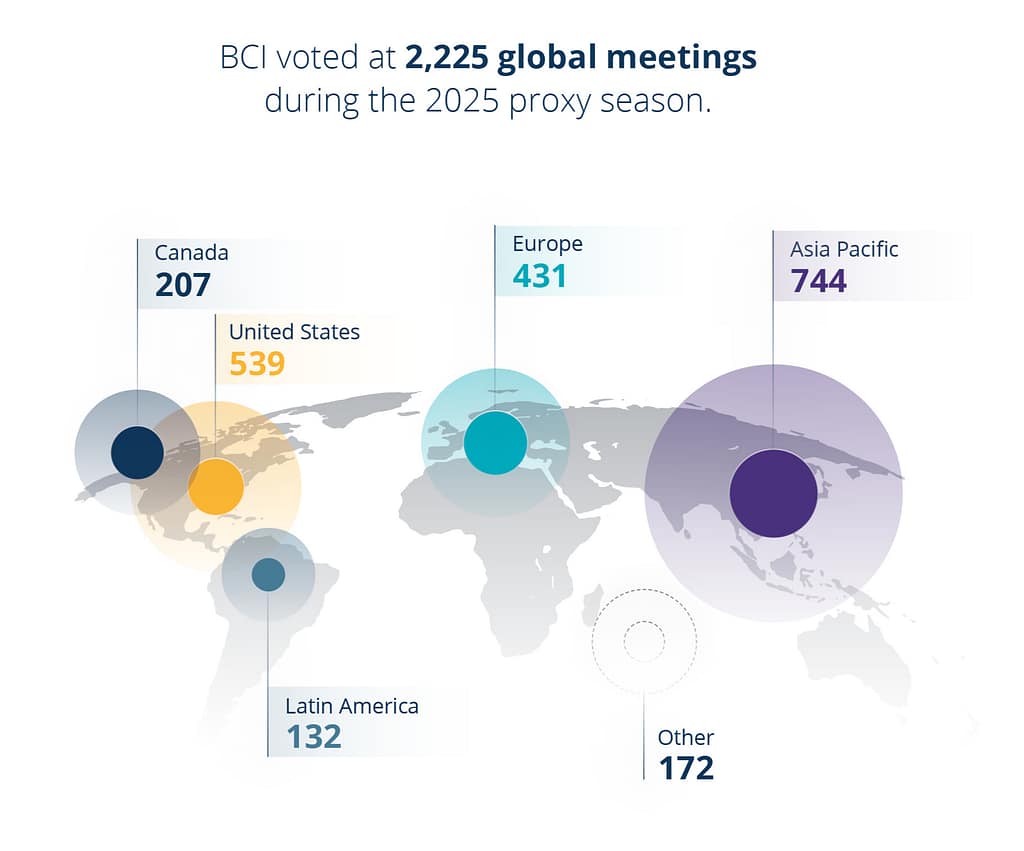
    Last year, BCI engaged 176 portfolio companies to address material risks and opportunities, and achieved its objectives or built positive momentum with 34 per cent of those companies. During the most recent proxy season, BCI voted at 2,225 public company meetings in 52 countries.  

    Notable engagement successes include completing a multi-year collaborative engagement with Teck Resources on climate risk, protecting minority shareholder interests during the acquisition of Atacadao SA, and contributing to the broader governance reform movement in South Korea that led to the country’s landmark Commercial Act amendments. Additionally, BCI’s position on stronger sustainability disclosures to support investor decisions continues to yield results. More than 35 jurisdictions covering 40 per cent of global market capitalization have now incorporated the International Sustainability Standards Board (ISSB) standards.1

    This year’s report also introduces BCI’s updated ESG engagement priorities – physical and transition climate change risk, responsible AI, and human capital management – which reflect the areas expected to have the greatest impact on investment performance in the coming years.  

    “As an active, long-term investor, BCI has a responsibility to help position our portfolio for the risks and opportunities ahead,” adds Coulson. “Every engagement, every vote, and every policy submission is ultimately about protecting and growing the assets entrusted to us by our clients.” 


    2024-2025 stewardship highlights


    • Emphasizing governance: BCI voted against or withheld our vote from 32 per cent or nearly 4,000 board directors across our global equities portfolio for reasons including insufficient independence, lack of board diversity, and problematic compensation practices. We pursued 56 engagements on corporate governance, reinforcing our foundational expectations and supporting board and management accountability.  
    • Managing climate risk: BCI continued to vote against board directors for lack of climate risk oversight and disclosure, and pursued 139 climate engagements in the energy, utilities, and financial sectors. Notably, we completed a seven-year engagement with Teck Resources that culminated in the company’s removal from the Climate Action 100+ target list based on its progress. 
    • Expanding influence in Asia: BCI deepened engagement in prominent Asian markets, including Hong Kong, India, Japan, Malaysia, Singapore, South Korea, and Thailand. We cast votes at nearly 750 annual meetings in the Asia-Pacific region and engaged with companies and policymakers alongside investor coalitions like the Asian Corporate Governance Association to raise market standards. 
    • Creating value in private markets: BCI engaged 16 private portfolio companies to strengthen alignment with our ESG expectations and support sustainability initiatives designed to deliver value at exit. We hosted an inaugural Private Equity ESG Value Creation Conference in New York, bringing together nearly 50 investment partners and companies to demonstrate the links between ESG and financial performance.  

    As a core aspect of BCI’s ESG strategy, this stewardship reporting complements the ESG and climate-related disclosures available in our 2024-2025 Corporate Annual Report. 

    Read the 2024-2025 Stewardship Report on BCI.ca 


    1IFRS Foundation Annual Report 2024 

  • BCI’s stewardship in Asia  

    BCI’s stewardship in Asia  

    Desktop

    BCI’s stewardship in Asia  

    News
    Back to News Back to News
    September 16, 2025

    With its rapid economic growth and favourable demographics, Asia is presenting increasingly attractive investment opportunities for global investors. BCI has exposure to the region through our active and passive public equities strategies, as well as direct investments in our Private Equity and Infrastructure & Renewable Resources portfolios – most recently in India, Japan, Malaysia, and the Philippines.  

    Our investment footprint means Asia is an increasing focus for BCI’s stewardship program. We are observing strong regional momentum for corporate governance reforms that will enhance shareholder value and ultimately accelerate progress on other material environmental and social issues – creating a compelling case for increased engagement. 

    Over the past two years, BCI deepened our efforts across Hong Kong, India, Japan, Malaysia, Singapore, South Korea, and Thailand through collaboration with international investors, participation in meetings with regulators and companies, policy consultation submissions, and ESG-related joint statements. This work aligns to our investment objectives, and we take a holistic view of advancing progress. 


    An integrated approach


    In Asia, BCI’s approach to stewardship combines company engagement with strategic policy input, recognizing these efforts are most effective when pursued together. To maximize our impact and resources, we also work in close collaboration with other global investors and industry organizations like the Asia Corporate Governance Association (ACGA) and Asia Research & Engagement (ARE). 

    Many companies are not only receptive to this approach but increasingly proactive in embracing organizational changes such as greater shareholder outreach, strengthened governance practices, and expanded ESG initiatives. Across our engagements, we are intentional about emphasizing the critical role that companies play in driving reforms and elevating these markets to align with global standards. 


    In action: Global sustainability disclosure standards 
    We continue to advocate for consistent, comparable, and quality ESG and climate disclosures aligned to the International Sustainability Standards Board (ISSB) standards. Over the past year, BCI responded to consultations with the Korean Sustainability Standards Board and Sustainability Standards Board of Japan, while participating in broader policy engagements alongside global investors, to advance mandatory reporting in these markets.In parallel, BCI engaged directly with portfolio companies. For example, supporting shareholder proposals at Japanese companies like Mitsui & Co., Mitsubishi Corporation, Sumitomo Corporation, and Chubu Electric Power Co. asking for increased disclosure on the impact of failing to meet a 1.5°C target under the Paris Agreement. In South Korea, we submitted questions at the annual general meeting (AGM) for SK Hynix Inc., a memory chip and semi-conductor company, on their emission reduction targets and renewable energy strategy.  


    Delivering investment value


    BCI’s ESG initiatives directly support the objectives and priorities of our investment teams, helping to deliver long-term, sustainable returns for our clients. We have dedicated ESG experts embedded across our business, working hand-in-hand with portfolio managers to factor ESG risks and opportunities into investment decisions.  

    Our focus in Asia is no exception. BCI’s regional activities are helping to shape the attractiveness of the market and address underlying risks that could impact long-term returns.  

    For example, BCI’s internally managed Active Emerging Markets Equity Fund has many years of experience in Asia-Pacific, providing valuable insight into the ESG topics and engagement opportunities across the region that could influence portfolio performance. The deep expertise and capital allocation perspective of the investment teams adds credibility to our overall approach with companies and regulators. 

    “Companies aren’t only hearing from a standalone ESG team – they hear directly from our portfolio managers who are actively allocating capital. This alignment gives BCI’s voice real weight and helps companies understand that ESG considerations are directly embedded into our investment decisions.”

    – Shannon Gong, Principal, ESG 


    In action: South Korea’s Corporate Value-Up initiative 
    Launched in early 2024, South Korea’s Corporate Value-Up Program aims to improve corporate governance and enhance shareholder value in response to South Korea’s persistent valuation discount compared to global peers. It also shows the country’s openness to hearing from international investors on governance reforms.Leveraging this opportunity, BCI increased our strategic collaborative engagement in the country. This included participating in an ACGA delegation to South Korea to meet with regulators and attend corporate AGMs, as well as supporting the ACGA Korea Working Group’s broader governance initiatives. We also co-signed a letter to the Financial Services Commission advanced by the Asia Investor Group on Climate Change and responded to policy consultations to enhance sustainability disclosures.A milestone for market reforms
    In 2025, South Korea’s National Assembly passed significant amendments to its Commercial Act, aimed at addressing the structural issues behind the country’s valuation discount. Through participation in investor coalitions, BCI contributed to the broader reform momentum that led to these changes.Notably, board director’s fiduciary duties were expanded to include shareholders alongside the company. Other improvements range from a higher threshold for board independence to mandatory electronic meetings, in addition to physical meetings, for listed companies with a market capitalization over KRW 2 trillion. A ‘3% Rule’ was also introduced, limiting the largest shareholders’ voting power to 3% when appointing audit committee members. The country’s primary stock market index (KOSPI) surged nearly 33% between January 1 and August 29, 2025, outperforming the MSCI Asia Pacific index, driven in part by optimism around governance reforms in addition to the new administration and other macroeconomic factors. 


    “With South Korea representing a significant part of BCI’s active global emerging markets equity portfolio, these improvements have direct relevance to our investment outcomes. Stronger minority shareholder protections and enhanced transparency support our investment objectives and should help address the country’s valuation discount over time.”

    – Jean-Christophe Lermusiaux, Managing Director, Global Emerging Markets. 


    Learn more about BCI’s approach in our 2024-2025 Stewardship Report . 

  • 2025 Proxy season in review   

    2025 Proxy season in review   

    Desktop

    2025 Proxy season in review   

    News
    Back to News Back to News
    September 16, 2025

    Guided by our belief that stronger ESG practices will ultimately lead to stronger performance,BCI uses our influence and shareholder rights to drive ESG improvements in our portfolio and across the broader capital markets.  

    Proxy voting is a crucial part of our stewardship activities. Share ownership comes with the right to vote at company meetings and participate in the decisions of the public companies that we are invested in. BCI takes this opportunity seriously and aims to vote at the meetings of every public company in our portfolio. We publish these votes ahead of each annual general meeting through a database on our website. 


    We vote according to our Proxy Voting Guidelines which are updated every two years to reflect the evolving expectations we have for the public companies in our portfolio. In 2025, BCI released the 12th edition of these guidelines, affirming our commitment to using our voting rights to uphold our expectations for robust corporate governance, protection of shareholder rights, and effective oversight of ESG risks and opportunities. 
    This voting season, spanning January to June 2025, was very active for BCI with 2,225 ballots cast globally, and we continue to see emerging trends in shareholder activity.


    BCI season snapshot

    2025 Proxy Season Summary

    Voted on

    29,182 agenda items

    Voted against or withheld votes from

    32% director nominees

    Voted in

    52 countries

    Voted on

    1,017 shareholder proposals

    Voted against management in

    26% of cases

    Supported

    48% of shareholder proposals


    Proxy season trends


    The 2025 proxy voting season revealed significant shifts in shareholder initiatives, marking a departure from recent trends in both the volume and nature of proposals submitted to public companies. 

    Results from North American annual general meetings (AGMs) offer insight into this evolution. We have observed a sharp decline in the number of shareholder proposals filed, with a 26% decrease in volume compared to 2024 – one of the most significant declines in recent years. The reduction likely reflects the guidance provided by the Securities & Exchange Commission (SEC) early in the season, which allowed more companies to exclude proposals that had already been filed, and a potential recalibration of shareholder activism strategies. Other notable observations include:  

    • Focus on traditional corporate governance priorities: For the first time since 2021, governance-related initiatives outnumbered environmental and social (E&S) proposals. Governance proposals received strong investor support above 30%, reflecting continued emphasis on board composition, accountability, and shareholder rights.   
    • Headwinds for climate-related proposals: Average support for climate proposals dropped from 25% to 10%, signaling shifting investor sentiment and selectivity. However, in Canada, support for proposals asking banks to disclose the extent to which they are  financing fossil fuels compared to cleaner energy sources via an “energy supply ratio” was markedly high with nearly 40% backing, bucking the downward trend. This suggests that investors are paying attention to financial institutions’ exposure to energy sector risks and opportunities. 
    • Challenges for diversity, equity and inclusion (DE&I) proposals: Support for DE&I proposals declined from 24% to 14%, with Equal Employment Opportunity-1 disclosure and racial equity audit proposals seeing increased backing, indicating higher investor appetite for transparency. 
    • Uncertainty about AI: Despite doubling in volume, support for AI proposals dropped from 17% to 10%, suggesting investor caution around this relatively new proposal topic and measures that could impact competitive positioning. 
    • Low support for anti-ESG requests: While we saw an increase in the number of proposals explicitly seeking rollbacks or an end to corporate activities addressing climate, DE&I, and other ESG topics, these proposals received consistently low support. With around 5% support, these proposals are unlikely to gain widespread favour.  

    We anticipate many of these trends will persist in future voting seasons, and expect to see continued strong support for governance-focused proposals and more nuanced investor expectations for environmental and social risk management.  


    BCI voting examples


    • Climate Change: BCI supported proposals asking BMO, CIBC, and TD to disclose their renewable versus non-renewable energy funding ratios. TD achieved 38% support – a record for a climate proposal at a Canadian bank – with CIBC and BMO receiving 37% and 32% respectively. 
    • Governance: BCI cast ballots for over 12,000 director elections, voting against or withholding our vote for 32% based on poor governance practices with insufficient independence representing over half of the votes. 
    • Executive Compensation: BCI voted against UnitedHealth Group’s executive compensation plan due to a problematic $60 million front-loaded stock option award for the CEO. Forty percent of shareholders opposed the plan, demonstrating significant concern. 
    • Responsible AI: BCI supported a shareholder proposal asking Amazon to disclose how AI data center expansion affects its climate commitments. The proposal received 20% support, representing strong shareholder backing. 


    Looking ahead


    Our work doesn’t stop at the ballot. After we vote, BCI directly follows up with select portfolio companies to ensure they understand our rationale and expectations. We also closely review our voting record to see how we made an impact and find areas to refine our approach. This review is an important step in preparing for any repeat shareholder proposals and will inform our biennial Proxy Voting Guideline update planned for 2027. 

    Proxy voting represents just one component of our comprehensive stewardship program, which also includes direct and collaborative engagement and policy advocacy work. As responsible stewards of our clients’ assets, this engaged approach is crucial to ensuring the long-term sustainability of our investments. 

    Learn more in our 2024-2025 Stewardship Report. 

    Sources: BCI, Institutional Shareholder Services, Morningstar, and RBC Capital Markets 

  • Susan Golyak: Canadian pension funds harness engagement, not just ‘proxy pen’

    Susan Golyak: Canadian pension funds harness engagement, not just ‘proxy pen’

    Desktop

    Susan Golyak: Canadian pension funds harness engagement, not just ‘proxy pen’

    Insights
    Back to Insights Back to Insights
    August 22, 2025

    Markets Group logo

    By Lauren Bailey

    PUBLISHED: August 22, 2025


    As debate surrounding the role of sustainability in investment strategies intensifies, leading Canadian pension funds are demonstrating how active ownership is helping them fulfill their fiduciary duty, while building long-term resiliency into their portfolios.

    During a recent discussion, Susan Golyak, director, environmental, social, and governance (ESG) at the British Columbia Investment Management Corp. (BCI) and Delaney Greig, director of investor stewardship at the University Pension Plan Ontario (UPP), outlined how active engagement, clear and consistent ESG integration, and proxy voting form the foundation of their funds’ sustainable investment frameworks.


    Beyond divestment


    While media headlines often focus on divestment, both Golyak and Greig stressed that divestment often can be the least effective tool in the sustainability toolbox.

    As a jointly sponsored defined benefit pension plan, UPP’s mandate is to invest in the best financial interests of its pension plan members, delivering secure, long-term retirement outcomes for its participants across Ontario’s university sector, said Greig. She noted that the $10B (C$12.8B) plan was designed, from its inception four years ago, with active ownership as a central pillar. While investment exclusion is a tool the fund can use to deal with industry or company-specific risk, she said there’s a much broader set of active ownership tools it relies on more heavily. Those tools include incorporating manager selection due diligence and ongoing monitoring, as well as direct engagement with companies, proxy voting, and policy advocacy on broader, systemic issues.

    “When we’re using those tools, we’re looking at things that . . . will affect the portfolio as a whole, like climate change and inequality that . . . play out on our diversified portfolio across our exposures. They’re not specific to whether one company is going to succeed or fail, [but more] about whether the entire portfolio or, in some cases, the entire economy, is going to [fail].”

    Golyak echoed this sentiment, noting BCI’s mandate is to invest its $212B (C$295B) assets under management in the best financial interests of its pension and corporate clients in the province. Together, its clients represent more than 725,000 beneficiaries, so protecting their financial interests is a top priority for the pension fund, she said.

    She noted broad-based divestment doesn’t serve that mandate, noting the fund isn’t interested in making decisions that exclude parts of the investment universe.

    “Our portfolio managers make decisions on a day-to-day basis in terms of adding and removing names from the portfolios for various reasons. But when it comes to broad-based divestment of companies, for example, those are decisions that we don’t believe are in the best interests [of our fiduciaries]. We think it’s much more important to maintain our ownership and engage with the company.”

    Like UPP, BCI uses many tactics to exercise its influence, but its core strategy is direct engagement with companies on material issues through collaboration with [peers] and other members of groups like Climate Action 100 and Climate Engagement Canada.

    While the pension fund has some exclusions based on federal government treaties, executing its votes through proxy-voting mechanisms is a major part of its stewardship activities. But from an overall risk management perspective, the investment teams integrate ESG considerations into every aspect of the investment process to ensure they’re mitigating risks associated with ESG factors and capturing opportunities, she shared.


    Harnessing the shareholder “voice”


    When used effectively, shareholder proposals can influence corporate behavior and safeguard returns in a market where ESG issues are increasingly viewed as financially material.

    “We believe ESG factors do make a difference to long-term returns,” said Golyak, noting that governance expectations form a large share of BCI’s voting activity.

    She said BCI has tightened its approach to shareholder proposals and proxy voting, issuing updated guidelines every two years to reflect shifting governance trends and evolving ESG concerns. The pension investment manager publishes a public version of its guidelines on a bi-annual basis, after consulting clients on potential revisions. The guidelines provide companies with a roadmap of how BCI is likely to vote and what practices it expects to see from corporate boards. BCI’s clients delegate the final authority on votes, and it is expected to make all decisions with their long-term financial interests in mind.

    The guidelines also link directly to BCI’s broader engagement priorities, aligning position statements, expectations, and voting actions to push companies toward improved practices. She added that beneficiaries often scrutinize the fund’s voting record and increasingly expect managers to hold corporate leadership accountable while supporting credible shareholder initiatives.

    “The ESG team creates the guidelines, executes the votes, and manages the relationship with the proxy voting service provider that facilitates the process,” said Golyak. “That accountability and mandate rests with us.”

    Internal portfolio managers are kept informed and engaged in discussions about upcoming votes, she said, noting collaboration with the investment team ensures alignment between proxy-voting decisions and the fund’s long-term sustainability objectives.

    UPP also leverages proxy voting as a direct tool to influence corporate behavior in ways that support positive outcomes for the fund and its members.

    The pension fund recently moved more of its proxy voting in-house, seeking greater consistency across its portfolio and closer alignment with beneficiaries’ long-term interests. Greig noted the pension investment manager has also been transitioning assets from pooled funds to segregated mandates, where possible, to “hold the pen” on proxy votes and ensure a unified approach to corporate governance across the portfolio.

    “Our only reason for voting is the long-term vested interest of our clients, as opposed to a manager who has multiple clients with different priorities,” Greig pointed out.

    When it comes to executing a vote, the fund considers portfolio-wide standards for governance, including expectations for board independence and auditor rotation. She said UPP votes with the broader market view in mind, favoring governance practices that have proven effective over time.

    While proxy advisory firms often draw scrutiny, Greig emphasized that these firms serve more as research providers than decision-makers. UPP relies on an external proxy research platform to handle the vast scale of global voting.

    “We vote across thousands of companies worldwide. We don’t have the time to sift through every disclosure ourselves — that’s where the external provider comes in.”

    The firm screens corporate disclosures against those guidelines and supplies relevant information, enabling the fund’s stewardship team to execute the votes. “In some senses, the term ‘advisory’ is a misnomer,” she added. “For us, they are a proxy research firm. They don’t decide how we vote — we do.”


    Transparency, communication key


    Proxy voting can be seen as a blunt instrument, so clear communication and transparency surrounding reasons a firm is casting its ballot in any direction is critical.

    “When we vote against a director or executive pay, we make a point of telling companies why,” said Greig. “Otherwise, they may not understand if it’s about governance, diversity, compensation, or another issue entirely.”

    One of the multiple channels UPP uses to increase transparency is a real-time, proxy-voting disclosure site that is updated as soon as votes are cast — sometimes even before annual general meetings. It also aggregates votes and rationales in its quarterly reports for easy access and sends direct letters to companies— particularly where engagement is ongoing or exposure is high — explaining the rationale for votes against management and requesting that their boards be made aware.

    The goal, she said, is to ensure companies understand the rationale underlying UPP’s votes. For instance, a vote against the chair of a nominations committee may stem from concerns about board diversity or board independence. Communicating the specific reasons demystifies the blunt instrument of a “yes” or “no” vote.

    Beneficiaries are another key audience. Making proxy policies, rationales for votes against management, and explanations for shareholder proposal decisions not only keeps beneficiaries informed but also allows them to hold the fund accountable, said Greig.

    As well, external stakeholders, including advocacy groups, may review and critique UPP’s voting record, she continued. “At the end of the day, it’s our policy and our analysis of long-term interests that determine how we vote. But it’s important to understand what other stakeholders are thinking as well.”

    Golyak agreed, noting BCI is comfortable providing regulators with either aggregated data or specific examples, showing how expectations are embedded in actual votes. “When regulators can review investors’ guidelines and see who plans to vote against directors — and why — that’s a compelling demonstration of our seriousness.”

    Republished with permission. Read the original article on Markets Group.